Should You Pay Off Your Mortgage Early?
The real math behind one of personal finance's most debated questions — and why most people get it wrong.
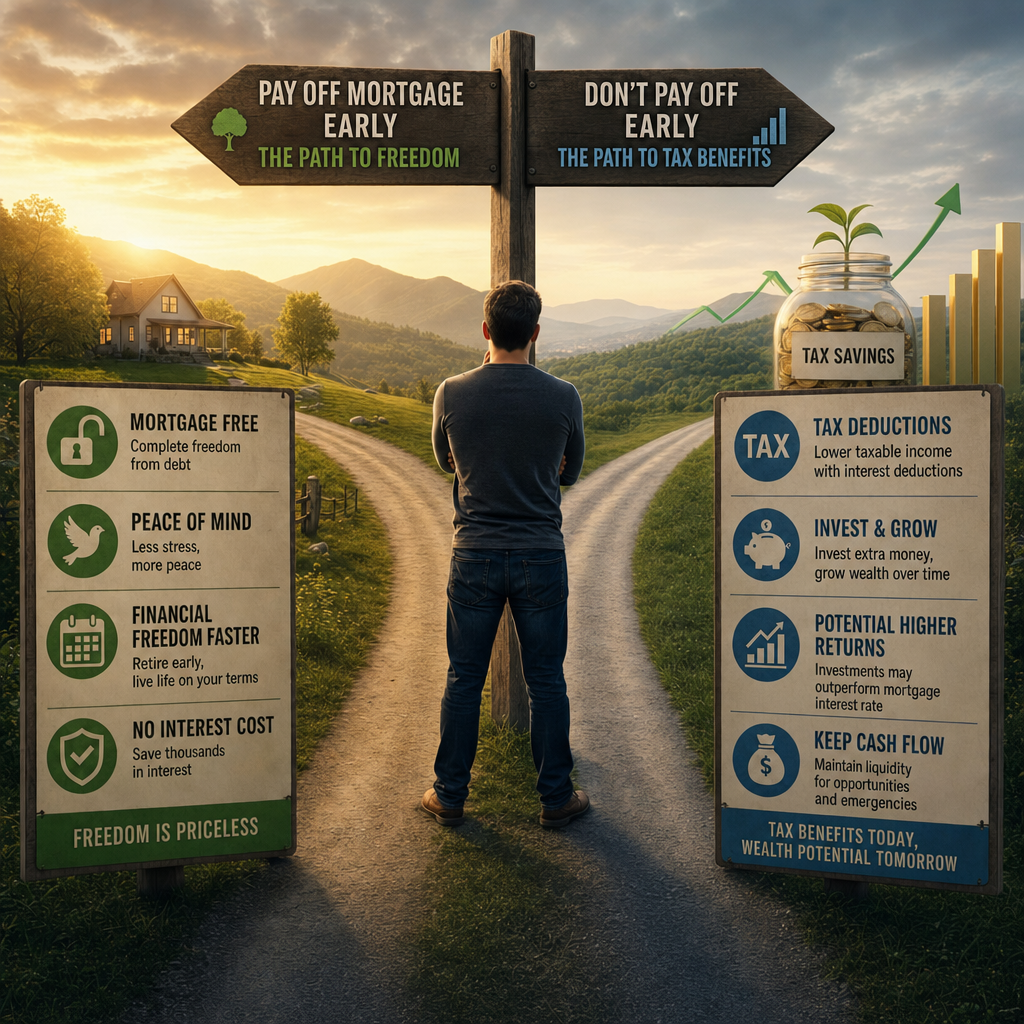
The real math behind one of personal finance's most debated questions — and why most people get it wrong.
If you have a mortgage, someone has probably told you two completely opposite things: "Pay it off as fast as possible!" and "Never pay it off early — keep the tax deduction!" Here's the truth: one of those pieces of advice is almost always wrong for you.
Let's break this down so clearly that a 5th grader could follow along — because this is one area where jargon tends to obscure a very simple truth buried in the numbers.
First, the scary math you need to see
Most homeowners have never actually looked at the total cost of their 30-year mortgage. When you do, the number is shocking.
| Home Price | Interest Paid | Total Cost |
|---|---|---|
| $400,000 | ~$408,000 | ~$728,000 |
| What you bought | At 6.5% over 30 yrs | What you actually paid |
That's right — you pay nearly as much in interest as the home itself cost. At higher rates or with a smaller down payment, the total can easily reach two or three times the original purchase price. The bank isn't just lending you money; they're becoming your most expensive long-term partner.
And there's another layer most people miss: mortgage amortization front-loads the interest. In the early years of your loan, your monthly payment looks like this:
| Monthly Payment | Goes to Interest / Equity |
|---|---|
| $2,000 payment | ~$1,700 interest / ~$300 equity |
| 85% of early payments go straight to the bank — not your ownership | |
This is why extra payments made early in a loan are so powerful — they short-circuit a system designed to collect as much interest from you as possible.
"You spent $10 to save $3. You are still losing $7."
The tax deduction myth
The most common argument for keeping a mortgage is the mortgage interest tax deduction. The logic sounds reasonable: you pay interest, you deduct it, the government subsidizes your debt. Here's why that logic collapses for most families.
How the deduction actually works
To use the mortgage interest deduction, you have to itemize your deductions instead of taking the standard deduction. Here's the problem:
| What You'd Itemize | Amount |
|---|---|
| Mortgage interest | $12,000 |
| Property taxes | $6,000 |
| Your total itemized deductions | $18,000 |
| Standard deduction (married, 2025) | $29,000 — you'd take this instead |
Result: you take the standard deduction anyway, and the mortgage interest does nothing for your taxes. About 90% of American taxpayers are in exactly this position.
And even for the 10% who do itemize, the math is still unflattering. If you paid $20,000 in interest and you're in the 24% tax bracket, your "savings" are $4,800. You still paid the bank $15,200 net. The deduction softens the blow — it doesn't change the fundamental equation.
The Bottom Line on Taxes
Most families receive zero tax benefit from mortgage interest. For those who do, the savings only reduce the cost — you're still paying far more in interest than you ever get back.
The case for investing instead
To be fair, the "don't pay off your mortgage" argument isn't just about taxes. The stronger version goes like this: if your mortgage rate is 5% and the stock market historically returns 8–10%, you come out ahead by investing the difference rather than paying down the loan.
On paper, this math can work. In practice, it requires three things to all be true at once:
- Your investments consistently earn more than your mortgage interest rate
- You actually invest the difference every month — not spend it
- The market doesn't drop significantly right when you need the money
None of those are guaranteed. But your mortgage payment never goes down.
Major market crashes — like the 50% drop in 2008 or the 20% decline in 2022 — have wiped out years of theoretical gains for investors who were simultaneously carrying mortgage debt. The math looks good in a spreadsheet. Real life is messier.
The case for paying it off
Now let's look at what's on the other side of the ledger.
| Benefits of Paying Off | Tradeoffs to Consider |
|---|---|
| ✓ Guaranteed return equal to your interest rate — no risk | ✗ Capital is tied up in home equity — less liquid |
| ✓ Saves hundreds of thousands in total interest | ✗ Opportunity cost if market returns outperform your rate |
| ✓ $2,000+ per month freed up as cash flow | ✗ Home doesn't produce income — it's a consumption asset |
| ✓ Financial cushion if you lose your job | |
| ✓ Lower stress, more flexibility, reduced required income |
Notice something about that tradeoffs column? The downsides are real, but they're largely theoretical. The benefits are concrete and guaranteed.
The one trick that surprises almost everyone
You don't have to choose between paying every dollar toward the mortgage and investing everything. There's a middle path that costs very little but delivers outsized results:
One Extra Payment Per Year
Making just one extra mortgage payment per year can cut approximately 8 years off a 30-year mortgage and save tens of thousands — sometimes hundreds of thousands — in total interest. That's one extra payment. Twelve months of discipline instead of thirteen. The compounding math is that powerful when applied to debt.
So what should you actually do?
It depends on your situation — but here is a simple framework:
| Pay It Off Faster If... | Keep the Mortgage If... |
|---|---|
| ✓ Your rate is above 5–6% | ✓ Your rate is very low (2–3%) |
| ✓ You are approaching retirement | ✓ You are investing the difference consistently |
| ✓ You don't itemize deductions | ✓ You itemize and receive the deduction |
| ✓ Financial stability matters more than upside | ✓ You need liquidity for business or investment |
| ✓ You are already investing elsewhere |
The Honest Takeaway
Most Americans overestimate the tax benefits of their mortgage and underestimate what the interest is actually costing them. For most families — especially those with rates above 5%, no itemized deduction benefit, and a desire for financial peace — paying off the mortgage 7 to 15 years early is one of the best financial decisions they can make. It may not be mathematically perfect. But it's the one most people will actually follow through on — and consistency beats optimization every time.
A Next Step
Whether you're weighing early payoff, building a tax-advantaged strategy alongside your mortgage, or just trying to understand where your money is actually going — let's look at your numbers together. In about 30 minutes, we can map out where you stand and what moves would strengthen your position most.
Schedule your session at www.speakwithjon.com
This post is for educational purposes only and does not constitute financial or tax advice. Every situation is different — consider speaking with a licensed financial advisor before making major changes to your debt strategy.
Tags: Debt Strategy | Mortgage | Tax Planning | Wealth Building
Important Disclosure
Downside Protection Clarification: References to "downside protection" or "0% floor" mean that your principal will not receive a negative interest rate credit during market downturns. This does not guarantee absolute principal protection against all risks, including insurance company insolvency or policy lapses.
Tax-Advantaged Accounts: Tax treatment depends on individual circumstances and may change. Consult with a qualified tax professional regarding your specific situation.
General Information: This content is for educational purposes only and does not constitute financial, legal, or tax advice. Individual results may vary based on personal circumstances.
Jon D. O'Neil is a licensed financial professional. For personalized guidance, schedule a consultation at www.speakwithjon.com
Found this helpful? Share it:

Jon D. O'Neil
Jon D. O'Neil is a wealth partner with over 10 years of experience helping clients achieve financial wellness through debt elimination, tax-advantaged accounts, and lifetime income strategies. Based in Lewisville, TX, Jon specializes in creating personalized financial solutions that provide stability and growth without market volatility.
Schedule a consultation →